
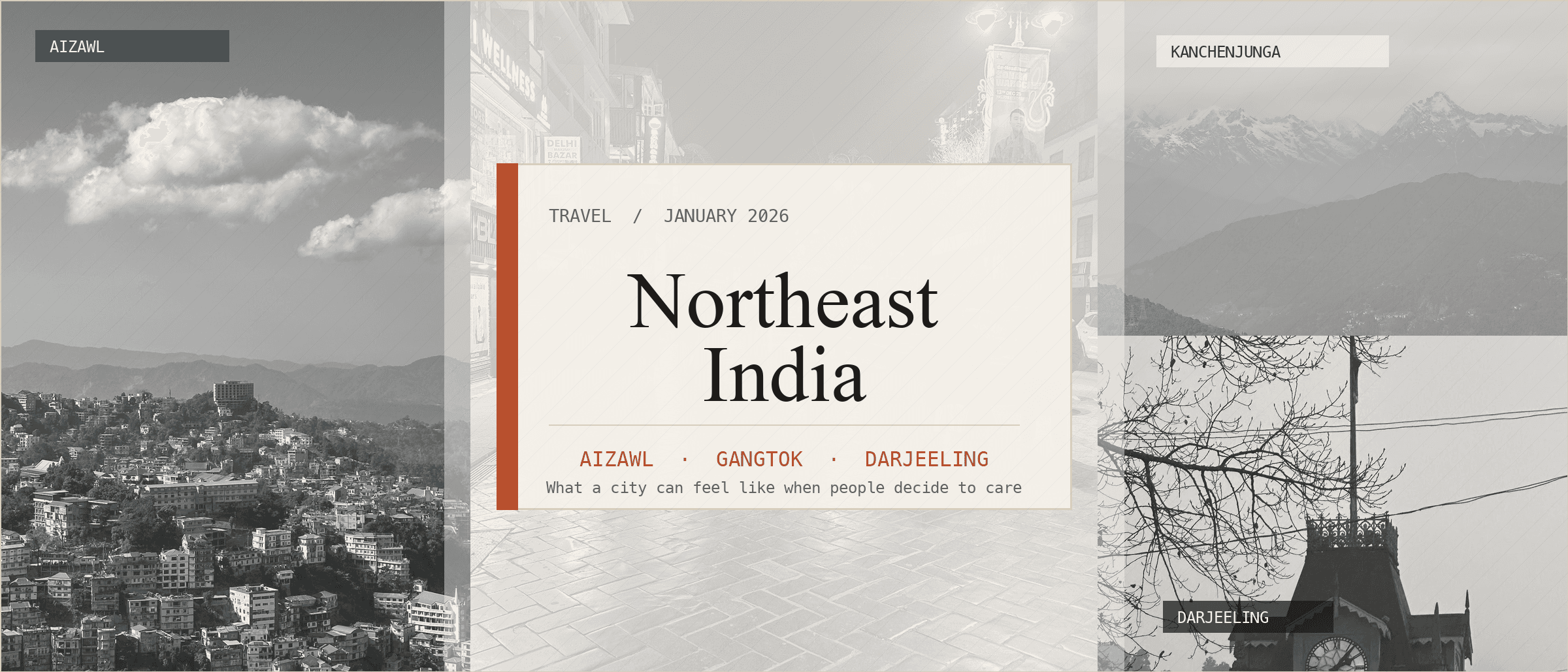
Northeast India Taught Me What a City Can Actually Feel Like
Two January trips to Aizawl and Gangtok became a lesson in civic ownership, trust, walkability, and what a city feels like when people quietly decide to care.
I went to Northeast India twice in January. First to Aizawl in Mizoram, then to Gangtok in Sikkim. Two different trips, two different companions, completely different contexts.
But both left me with the exact same feeling.
The Taxi Driver Who Didn't Try to Cheat Me
You land in Aizawl and you need a cab. In most Indian cities, that's where the negotiation begins - the inflated quote, the back and forth, the mild frustration before you've even started the trip.
Not here.
Every taxi driver quotes you the same rate. There's no game being played. No one is sizing you up as a tourist and adjusting the number accordingly. You pay what everyone pays, and you move on.
That one moment set the tone for everything that followed.
What "Discipline" Actually Looks Like
Both Aizawl and Gangtok are real cities. They have traffic, commerce, crowds, noise. I'm not talking about quiet hill towns where life moves slowly by default.
What's different is how people operate inside that hustle.
The streets are clean - not "clean for India" clean, actually clean. Footpaths exist and they are continuous. That sounds like a low bar, but if you've walked in any metro or tier-2 city in India, you know what I mean. You're constantly hopping off the footpath onto the main road because someone parked a bike on it, or because it just ends. In Aizawl and Gangtok, you can walk for long stretches without once stepping onto the road. The infrastructure respects the pedestrian.
One evening in Aizawl, I saw local women - not sanitation workers, just residents - out on the street cleaning their own neighborhood. Nobody asked them to. That's not civic duty, that's ownership. There's a difference.
What the Community Is Built On
A lot of Aizawl's social fabric runs through the Presbyterian Church and local community groups. You see it in how people show up for each other, how youth take initiative, how the city maintains itself without it feeling like a top-down enforcement thing.
And then there's football. Everyone in Aizawl is obsessed with it - kids, old men, everyone in between. It's the universal language. It gives the city a shared pulse.
The fashion is another thing I didn't expect. People in Aizawl dress with real intention. Not in an over-the-top way, but in a "I thought about this" way - layered jackets, good color combinations, mufflers that aren't an afterthought. When people care about how they look and how their streets look, the whole vibe of a city shifts from chaos to culture.
Something else I noticed - and this one genuinely surprised me. The locals speak English with confidence. Not hesitantly, not with apology. They communicate clearly, directly, and well. In a country where English fluency is often tied to class or education signals, seeing it used so naturally and confidently by everyday people in a small northeastern capital felt refreshing. It added a layer of ease to every interaction.
Aizawl - The Spontaneous One
The Mizoram trip was unplanned. A two-minute decision, a call made, and suddenly we were going.
I went with Sangam, my jijaji. He's a self-made guy - someone who has built his life through his own work, his own thinking, his own decisions. Being around people like that has a quiet effect on you. You observe how they move through situations, how they think, how they talk to strangers. You pick things up without even realizing it. This trip was that kind of experience.
We didn't rush. No packed itinerary, no checklist of sights. We let the city show itself.
One person who made the trip was John - a professional connection from Monks. We know each other through work, not through years of friendship. And yet, when we landed in his city, he showed up. He came and took us around, introduced us to places, and even briefed our taxi driver with an itinerary of spots worth visiting. I've seen closer friends make excuses when you visit their city - too busy, maybe next time. John had no obligation and made none. That kind of generosity from someone you know professionally is something you don't forget easily.
He took us to a great cafe. Good coffee, good conversation. The kind of afternoon that only happens when you're not in a hurry.
One night - around 9 or 10 PM - we stumbled into Chopstyx completely by accident. The service was genuinely good, the place had a great vibe, and they had a chili potato that I still think about. Not the Indo-Chinese version you get everywhere. This had its own spices, its own flavors. Something I hadn't tasted before and haven't since.
The moment that stays with me is from a barber shop. Sangam walked in for a haircut. The barber found out he was from the UK. No upcharge, no tourist pricing. Instead, he said he wouldn't charge this time - come back next time and pay then.
That kind of trust, extended to a stranger, is rare anywhere in the world.
Gangtok - The One That Felt Special
The Gangtok trip came together as a longer route - Kolkata by flight, then an overnight train to New Jalpaiguri, then by road up to Gangtok, and finally Darjeeling before heading back. My cousin Shantanu planned and sponsored the whole thing.
Shantanu is one of those people who has been there through your highs and your lows without making a big deal of either. Emotionally intelligent in a way that's rare - the kind of person who knows when to talk and when to just be present. Traveling with someone like that changes the texture of a trip. You're not just moving through places, you're actually present in them.
Darjeeling deserves its own mention. It has a distinct soul - British architecture, clock towers, cold air, great food. I had watched Barfi years ago, and that film does something to you emotionally. Walking through Darjeeling, I could feel the movie. The winter, the streets, the vibe - it all matched something I'd carried from that film for years.
But Gangtok hit differently.
I didn't try to cover a lot of ground. That was intentional. The point wasn't sightseeing - it was absorbing. The cleanliness, the greenery, the general happiness of the people around you. It's one of those places where the atmosphere itself does something to your mood. Happy people have a way of making you feel like things are okay. Gangtok has a lot of happy people.
What These Cities Are Actually Doing Right
I've thought about why Aizawl and Gangtok feel so different, and I keep coming back to a few things.
Civic ownership. People treat their public spaces like they belong to them - because they act like they do. The footpaths aren't occupied. The streets aren't dumping grounds. There's a collective standard being maintained without anyone enforcing it loudly.
No extraction mindset. In a lot of tourist-adjacent cities, visitors are resources to be mined. In Aizawl and Gangtok, that just isn't the operating model. People are helpful because that's who they are.
Walkability as a design choice. Continuous footpaths, foot overbridges, roads that feel safe to cross - these aren't accidents. Someone decided this mattered. And it makes an enormous difference to how a city feels to live in, even temporarily.
The People Make the Place
I keep coming back to the people.
Not just the cities, not just the infrastructure. The people. Sangam, who made a spontaneous trip feel grounded. Shantanu, who made sure I got to experience a part of the country I hadn't seen. John, who showed up when he didn't have to. The barber who extended trust to a stranger. The women cleaning their street at dusk. The taxi driver who quoted a fair price without being asked.
None of these are grand gestures. But together, they add up to something. A feeling that you're in a place where people have decided - collectively, quietly - to be decent. To take care of things. To not make life harder for the person next to them.
That's rare. And it's worth saying out loud.
Go, If You Haven't
I'm not a travel blogger and this isn't a travel guide.
But if you've been sitting on a Northeast trip, go. Without a full plan. Walk more than you intend to. Eat at places you find by accident. Talk to people.
Northeast India has something that most of the country is still figuring out. I went twice in the same month and I'll go again.
Have you been to Aizawl or Gangtok? I'd love to know what you took away from it.