
The Weekend I Decided Not to Leave Pondicherry
In early 2021, I went to Pondicherry for a weekend. On Sunday, I asked my cousin to return to Chennai without me. I stayed for six weeks, and it became the trip that taught me how to travel alone.
On a Sunday afternoon in early 2021, a cab was waiting to take my cousin and me from Pondicherry back to Chennai.
Instead of getting in, I asked him to drop me at Rock Beach.
“You go. I’ll stay here.”
I did not have a room booked. I did not know how long I wanted to stay. I was not in a particularly comfortable financial situation either. Business was going well in one sense: we were working on good projects and generating revenue. But it was a complicated setup, and that money rarely seemed to reach my own pocket.
Staying behind was not a sensible decision.
My cousin knew my ways. He didn’t ask questions or try to change my mind. He simply gave me the space to sit with my thoughts, then continued towards Chennai.
That was how a weekend trip became my first real solo journey.
Before Pondicherry, I was tired all the time
I had gone to Chennai because I needed a breather.
COVID had reduced life to the same rooms and the same screen. Travel had almost disappeared. Work continued from home, along with all the hustle around it, but there was no real change of scene. I felt tired in Delhi. I still felt tired after reaching Chennai.
Then we went to Pondicherry for the weekend.
It was around March, and it was hot when I first reached Rock Beach. I had seen the sea before, so it was not the novelty of seeing water for the first time. But the moment I looked at it, something shifted.
I wanted to stay there.
I still cannot explain why that particular beach affected me so strongly. Nothing dramatic happened. I just felt good. Utterly happy, in fact, in a way I had not felt for a long time.
For the next two days, I barely slept.
I stayed at the beach late into the night, then returned at around five in the morning to watch the sunrise. One of the first videos I made in Pondicherry is of that sunrise at Rock Beach. Looking at it now, I can see what I was trying to hold on to: the feeling of being completely awake.
At home, even after sleeping properly, I had felt drained. In Pondicherry, I could stay out half the night, wake before sunrise, and still feel fresh.
Maybe that is why I stayed behind on Sunday. I had finally found some energy, and I was not ready to return to the version of life in which I was always tired.
The payment that made staying possible
Soon after the cab left, while I was sitting near Rock Beach and wondering what I was going to do next, I received a call. Not long after that, a decent payment reached my account.
The timing was so strange that it almost felt as if Pondicherry itself wanted me to stay. A few minutes earlier, staying had been an impulse I could not really afford. Suddenly, I had enough breathing room to make it possible.
I booked an inexpensive Airbnb close to Rock Beach and began living there.
My days were not a holiday. I worked for most of them. The difference was that whenever I had time, I could step outside and walk. I spent hours around Rock Beach and White Town, enjoying the fact that I did not need an itinerary or a reason to be anywhere.
Small things felt different
One thing kept happening during those weeks: ordinary experiences surprised me.
Food was a big part of it. Before that trip, much of what I knew about South Indian food came from the familiar restaurant vocabulary of Delhi: idli, dosa, sambar, uttapam. In Pondicherry, I started to understand how incomplete that vocabulary was.
You could sit down for a saddam saapad, an unlimited meal, for around ₹100. A filling plate of idli-sambar cost almost nothing. A small tea or filter coffee could be ₹15. The juices kept the fruit fibre. Lemon soda arrived as actual soda rather than the water-and-soda mixture I was used to in Delhi.
These were tiny details, but together they made things feel simpler and somehow purer. Nothing was trying too hard. It was just good food, made well and priced so that it could remain part of ordinary life.
Pongal became a favourite. I discovered ice apple, Burmese atho, porotta with kurma, Sri Lankan food, and a cashew uttapam I still remember. Auroville opened another door through authentic pizzas, coffee, kombucha, and food from cultures I had previously experienced mostly through adapted restaurant versions.
I was not travelling with a checklist, but every day seemed to place something unfamiliar in front of me.
I reached Auroville without knowing where I would stay
After a few days in Pondicherry, I checked out of the Airbnb, packed the few belongings I had, and went directly to Auroville without a booking or any idea where I would stay.
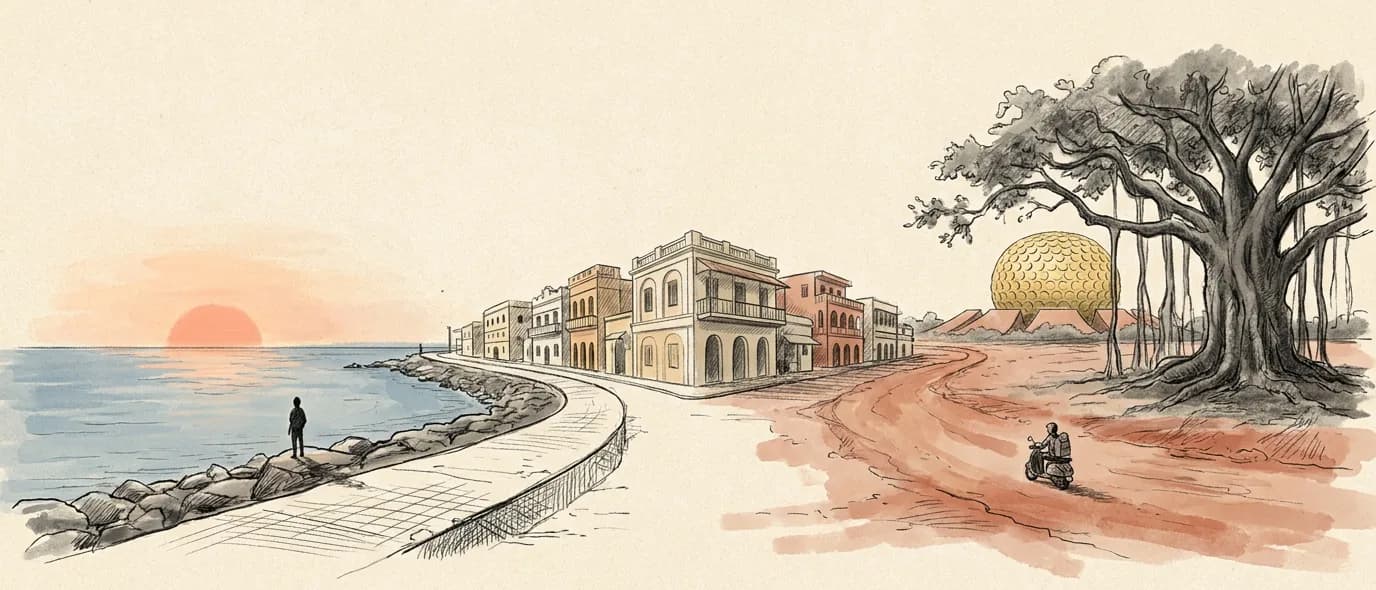
I knew very little about it beyond Matrimandir and what someone had told me: you could find random foreigners roaming around on mopeds. I made my way to Matrimandir first. Nearby, I saw the largest banyan tree I had ever seen.
I was also fortunate. I met two Malayali guys there, and the three of us piled onto a single scooter with all my luggage. They showed me around Auroville and eventually took me to the hostel where they were staying.
It was called Woodpecker.
The stay cost around ₹450 a day at the time. I had arrived with one T-shirt, one pair of shorts, one pair of trousers, one shirt, and one pair of shoes. That was it. I stayed so long without buying anything new that, after a month, people could recognise me from behind by my clothes.
That is how frugally I lived there. I did not rent a scooter, and I barely spent money on anything beyond the stay. Whenever I travelled around Auroville, it was usually with a different person I had met, on a different day. The place opened itself to me through people.
The one thing I allowed myself to spend on was food because the cafés introduced me to things I could not easily find back home. At Kompfu, Anandi akka’s place, I ate completely uncooked food that had no business being as delicious as it was, along with kombucha. I kept finding new favourites at Tanto’s Pizzeria, Solar Kitchen, Dreamer’s Café, and Auroville Bakery. Marc’s Coffee became another favourite.
The hostel owners were Sindhi, and many of the people around me spoke Hindi. We became close enough that, after a point, they stopped charging me for food.
What I expected to be another short stop became a stay of more than a month.
I became a different traveller there
Before Pondicherry, I had travelled, but usually towards someone I already knew.
In 2018, for example, I went to Kerala, but the same cousin was already there. I travelled with him. Other trips also had familiar people built into them.
Auroville was different. I began meeting people from other states and nationalities without having someone familiar beside me. I had never been particularly extroverted while travelling, but at Woodpecker I became much more open.
One afternoon at Marc’s Coffee, I overheard a man speaking to the café owner about what sounded like an investment. I could tell he was from North India, but what really caught my attention was the calmness in his voice. He seemed interesting, and for some reason I felt I should speak to him.
Normally, being an introvert, I might have let the moment pass. Instead, I gathered the courage to stop him and start a conversation. He was in a hurry, so after we spoke briefly, he took my number and said he would call.
I did not expect him to. In the startup culture I had known, “I’ll call you” often meant that you would never hear from the person again.
Some time later, he called. He came to Woodpecker, picked me up, and took me out for food. The conversation kept becoming more interesting. We discovered that he had once lived around five hundred metres from my home, and that one of my former colleagues had also worked with him.
That small encounter gave me the courage to keep reaching out. Not every conversation would become a friendship. Some people would stay and some would not. But I no longer needed to know the outcome before saying hello.
I made good friends. I joined long nights that moved easily from conversations to music to parties. I helped organise Woodpecker’s first Holi party in Auroville. I met people whose lives, beliefs, and backgrounds were completely different from mine, and instead of keeping my distance, I found myself becoming part of it all.
One person I met practised Reiki. When I had a headache, he offered to treat it by moving his hands around my head. His explanation involved manipulating waves. I cannot tell you whether that is what happened or whether he simply convinced my mind to let go of the pain.
I only know that the headache disappeared.
That experience sums up something about who I was becoming there. I did not need to arrive at a final opinion about everything. I could meet someone, try something unfamiliar, enjoy it, and allow a little uncertainty to remain.
The strangest change was my energy.
I could be at a party until four or five in the morning, then feel completely fresh for a seven o’clock meeting with a US client. This was not sustainable behaviour, and I would not recommend it as a routine. But during those weeks, I felt more alive with two hours of sleep than I had felt after months of staying home.
One song stayed with me through all of it: “Nee Neeli Kannullona” from Dear Comrade. During the first two days especially, I was completely absorbed in it. Even now, the song and that first arrival in Pondicherry are difficult for me to separate.
The first six weeks
I stayed in Pondicherry and Auroville for roughly a month and a half.
The trip did not solve the complicated parts of my work or finances. It did not give me a perfect new life. What it gave me was simpler and, eventually, more important: proof that I could leave the familiar behind and still find my way.
I kept returning after that first stay. Years later, after several visits, I would even open a restaurant there. But that belongs to another story.
This one ends with the first six weeks, because that is when the essential change happened.
What began there was not simply my relationship with a place. It was the first time I travelled without needing someone familiar at the other end. Most of my journeys since then have been solo.