
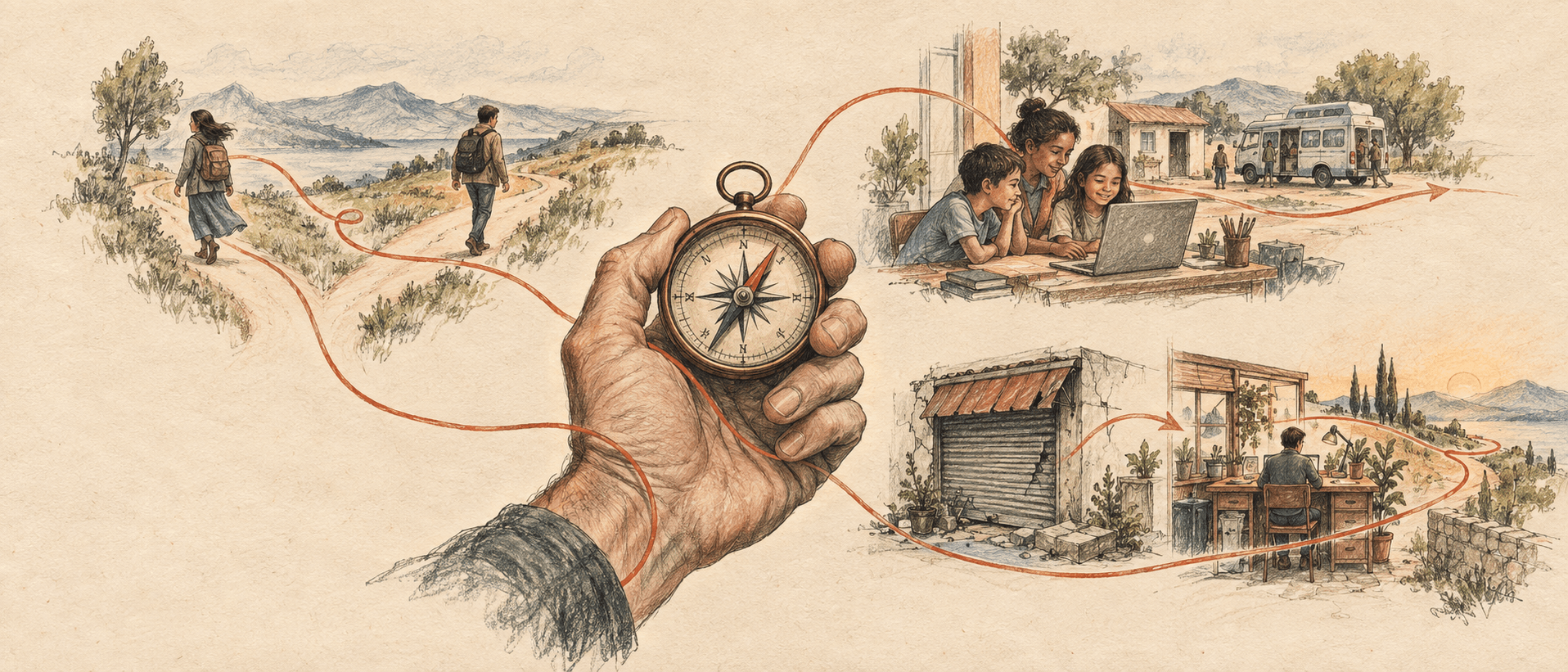
The Art of Conviction
A failed relationship does not make love false. A lost job does not make you incapable. Conviction is how you stay open without surrendering your judgment.
Listen to this article
18:05 · Narrated by Aanand Madhav
There is a kind of conviction that has nothing to do with being loud, stubborn, or certain that you will always win.
It is quieter than that.
It is the decision to continue believing in beautiful things after your experience of them has been painful.
A relationship ends. A friend turns away. A career collapses. Somebody takes advantage of your willingness to help. These experiences can teach you something useful, but they can also teach you the wrong lesson. They can make you conclude that love is false, friendship is transactional, kindness is foolish, or that you were never capable in the first place.
Conviction is the refusal to let one broken expression of something become your definition of the thing itself.
One relationship ending does not erase love any more than one person's disbelief erases God. I first heard a version of this comparison in Harmeeet's "LET GO" performance on Hustle 5: Apna Homeground. A particular relationship between two people did not work. That is painful, sometimes devastating, but it is still a much smaller statement than saying love does not exist.
This distinction has saved me in more areas of life than one.
Love and a relationship are not the same thing
You can love somebody deeply and still fail to build a life with them.
Love is a feeling, but a relationship is also a practice. It has to survive timing, behaviour, communication, family, money, expectations, emotional intelligence, social conditioning, and two people carrying histories that existed long before they met each other.
Sometimes the feeling is real and the practice fails.
Maybe you were going through the worst period of your life. Maybe your reactions kept hurting the other person. Maybe you could not understand what they needed, or they could not understand what you were trying to give. Maybe the two of you were sincere and still completely wrong for each other in that season.
None of this excuses harm. Loving someone does not free you from taking responsibility for the ways you hurt them. If you behaved badly, you have to look at it honestly, apologise where an apology is possible, and change what needs to change.
But accountability and sincerity can exist together.
You may have loved someone and still lacked the emotional tools to sustain the relationship. You may have been called selfish, dishonest, or toxic. Perhaps some of that criticism was deserved. Even then, your worst behaviour does not have to become the final verdict on your capacity to love.
Learn from what failed. Do not turn it into proof that the feeling was false or that you are permanently disqualified from it.
Keep your heart open, not unprotected
Remaining open does not mean returning to every person who hurt you. It does not mean accepting betrayal, abandoning your self-respect, or calling every attachment love.
An open heart still needs judgment.
You can forgive and leave. You can wish somebody well and never speak to them again. You can recognise that love existed while also recognising that the relationship must end. You can become more careful without becoming cynical.
This is where conviction is different from denial. Denial repeats the same pattern and insists that nothing is wrong. Conviction learns, adjusts, and still refuses to close.
When trust breaks, the easy response is to build a philosophy around the injury. Everybody cheats. Nobody stays. Friends disappear when life becomes difficult. Good work is never rewarded. Helping people only makes you a fool.
These sentences feel like wisdom because they protect us from surprise. In reality, they often turn one person's failure into a rule for everybody we have not met yet.
I do not want someone from my past to have that much power over my future.
Love is larger than romance
Romantic love receives so much attention that we begin to treat it as the only form that counts.
It is not.
Love can arrive through your parents, a friend, a child, an animal, a book, a craft, a place, a practice, or God. It can be the quietness you feel during yoga. It can be the care with which you make coffee for somebody. It can be the dog who waits at the door, the friend who does not change their tone when your life falls apart, or the parent whose everyday acts become visible only after somebody else treats your care casually.
I once heard comedian Rajat Sood describe, in an episode of The Prakhar Gupta Xperience, how heartbreak changed the way he saw his parents. Before the relationship ended, he had spent years thinking about what they did not understand or did not do for him. Then he gave his heart to someone who did not respect it, and suddenly he could see the hundreds of unremarkable ways in which his parents had been loving him all along.
The heartbreak did not leave him with less love. It redirected his attention towards love that had been present but unnoticed.
That is one reason I do not think we should search for love inside a narrow specification: a particular kind of partner, a particular face, a love marriage, an arranged marriage, or even marriage at all. The more tightly we prescribe its form, the easier it is to miss the feeling when it arrives differently.
Be open to love before you decide what container it must come in.
Some friends leave when your luck changes
I have lost many friends over the years. Some friendships ended because I have a few principles and non-negotiables I cannot bargain away. Others changed when my circumstances changed.
When my business was struggling and my career was at its lowest point, some friends slowly stopped including me in their lives. People who once told me everything began telling me nothing. Meetings became less frequent. Conversations became thinner. At times I felt as if I had become inauspicious, as if sharing good news with me might somehow spoil it.
I made efforts from my side. Then, when continuing began to cost me my self-respect, I let some friendships go.
It would have been easy to conclude that friendship itself was unreliable. Instead, I stayed available to new people.
New friends came. They did not judge me by the condition in which they found me or speak to me as if failure had lowered my value. Some helped with money or practical problems. Even those who could not help did something equally important: their behaviour towards me did not change. Several showed up more meaningfully than people I had known for years.
I could receive those friendships because I had not decided that friendship was over for me. I was still willing to enter it fully.
That willingness matters. If you want a deep friendship but offer everybody only the guarded remains of your old ones, the people in front of you are being asked to pay for a debt they did not create.
What Computer Campus taught me
During college, I ran an initiative called Computer Campus. I travelled to small villages and worked with NGOs to teach people how to use computers, smartphones, and the internet. The resources were limited and much of the work was improvised, but I saw how access to information and a little encouragement could widen someone's sense of what was possible.
During that journey, I once agreed to help organise a robotics workshop for children. The request came late in the afternoon, and by then every school I contacted had closed. The obvious routes were gone. Even without a clear plan, I had the conviction that I could solve the problem.
So I went into the neighbourhoods and spoke to children who were playing in the streets. I explained the workshop and asked them to take me to their parents. Some parents said yes and some said no, but gradually a group came together. At the same time, my friend Kiran found a friend connected to an anganwadi and arranged another group of students. My friend Anand arranged the cab service and took responsibility for transporting everyone. By the next morning, nearly seventy children were at the workshop.
The event went well, but my experience with the organiser did not. Important promises were not kept. I could have allowed that one experience to make me cynical about helping people or organising work like this. Instead, I learnt to be more careful about commitments and responsibility without becoming less willing to serve.
I kept going. I taught in schools and colleges and continued taking practical knowledge to people who might not otherwise have received it.
Years later, I began receiving SMS messages and emails from students I had taught for only ten or fifteen days. One told me they had made it to IIT. Others had opened a cafe, started a business, or found the courage to begin something of their own. Some said that something they had learnt from me, or the confidence they found during those sessions, had stayed with them.
That is the real story of Computer Campus for me. The disappointing organiser was one incident. The work travelled further than I could see at the time. Conviction, in this case, was refusing to let one person's conduct decide whether the work itself was worth doing.
Conviction after professional failure
When my business shut down, I needed a job for reasons that went beyond income. I needed to rebuild my sense of self-worth. My old partnership had revolved around the message that I was not worthy enough, even though I had been responsible for running the whole show.
People around me advised me to take any small role I could find, even if it was unrelated to the work I had spent years learning. The advice was practical and came from concern.
But I also had a conviction about the value I could create. The business had failed. That did not mean every skill I had built inside it had disappeared.
I kept applying and pushed myself towards the level of work I believed I was ready for. Eventually, I found the kind of role I had been aiming for.
That experience did not prove that conviction magically produces a result. It proved something more useful: failure is evidence about an attempt, not a complete assessment of a person.
The same lesson returned when I tried to travel to Europe. My visa was rejected twice. The trip was close, the bookings were made, and there were only days left. I could have treated the rejections as a final answer. Instead, I went back through the process, understood it for myself, tried once more, and received the visa in the final week.
I have written the full story in Five Years to Web Summit. What stayed with me was not only that I finally travelled. It was the discovery that a rejection can be information without becoming identity.
Goodness is not a transaction
One of my earliest inspirations on this question came from an Itachi Uchiha motivational speech built around a stark line: "There is a curse that follows the good."
It gives voice to a question I hear often: I am a good person. I have tried not to hurt anyone. Why do people who lie, betray, or behave badly appear to be succeeding? Why do they sometimes look happier than I am?
The question assumes that material success is a moral reward. I do not think life works that way.
Hindu stories helped me understand the distinction. We repeatedly see devas and asuras undertake tapasya and receive boons. The divine does not always refuse an asura simply because his intentions may later become destructive. He has practised discipline, endured hardship, and worked towards something, so that effort produces a result. The boon is not a certificate of moral goodness. It is a consequence of the work.
Worldly achievement often responds to effort, focus, strategy, timing, and persistence. A cruel person can possess all five and succeed. A kind person can neglect them and fail. Being good does not remove the need to work, and getting what you worked for does not prove that you are good.
Karma and the spiritual journey operate on a different plane. I do not understand karma as an instant scoreboard where every kind act quickly becomes a promotion, a relationship, or money. Its deeper consequences appear in the mind you build, the peace you can carry, the patterns your actions set in motion, and the person you become over time.
This is also why conviction cannot mean that life owes me success because I behaved well. Conviction means I will work intelligently for what I want without allowing disappointment to make me cruel. I will not turn goodness into a bargain that I honour only while it is profitable.
The speech matters to me not because good people are destined to suffer, but because it asks whether pain will decide our character. Staying good when goodness receives no immediate reward is its own form of strength.
What conviction is really protecting
Conviction does not protect a particular relationship, job, friendship, or plan. Many of those will still end.
It protects your relationship with possibility.
It protects the belief that you are still capable of loving after love has gone badly. That you can still build a friendship after a friend has disappointed you. That your work can still matter after a business fails. That generosity can remain part of your character after somebody exploits it.
There is a mental cost to losing this belief. You begin to approach every new person as a future betrayal and every opportunity as a future humiliation. You may call it realism, but often it is fear making decisions in advance.
There is also a physical way we carry that fear. We hold ourselves back. We leave early. We stop calling. We do not apply. We refuse help before anybody offers it. We avoid the places where hope might make us look foolish again.
And there is a spiritual cost. Whatever name you give it - faith, God, grace, or simply life - remaining open is a way of admitting that your past is not the full measure of what can still happen.
Conviction keeps that door unlocked.
Try again, but do not return unchanged
I am not asking anyone to become naive.
If somebody betrayed you, learn how trust was misplaced. If a friendship became humiliating, strengthen the boundary you ignored. If your business failed, understand the numbers and the decisions that led there. If you hurt someone you loved, do not hide behind the purity of your intention. Become better at the practice, not only more poetic about the feeling.
Then try again.
Try again with sharper judgment and the same depth. Try again without demanding that the next person repair what the previous one broke. Try again knowing that success may take a different form from the one you imagined.
Maybe love reaches you through a person whose life, conditioning, and timing finally fit yours. Maybe a relationship lasts for the rest of your life. Maybe it comes through marriage, without marriage, or after you have stopped trying to force it into a familiar story.
Maybe the career you build looks nothing like the one you first trained for. Maybe the friend who stands beside you at your lowest point is someone you have not met yet.
There are no guarantees in any of this. Conviction is not a contract with the universe.
It is a way of refusing to abandon the most alive parts of yourself before life has finished answering.
Keep your eyes open. Keep your boundaries. Learn everything the loss came to teach you.
But keep your heart open too.